


The application of geocells in retaining wall engineering is an ecological, flexible, and economical solution that combines modern geosynthetic technology with traditional retaining structure concepts. It utilizes the lateral confinement effect of a three-dimensional honeycomb structure to significantly enhance the integrity and load-bearing capacity of the fill material, thereby achieving multiple functions such as retaining, corrosion prevention, and greening.
The following are the specific application details of geocell retaining walls:
1. Structural Form and Principle
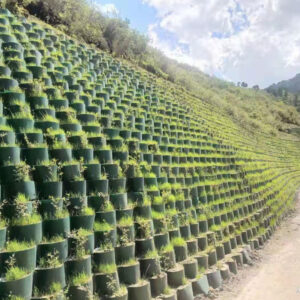
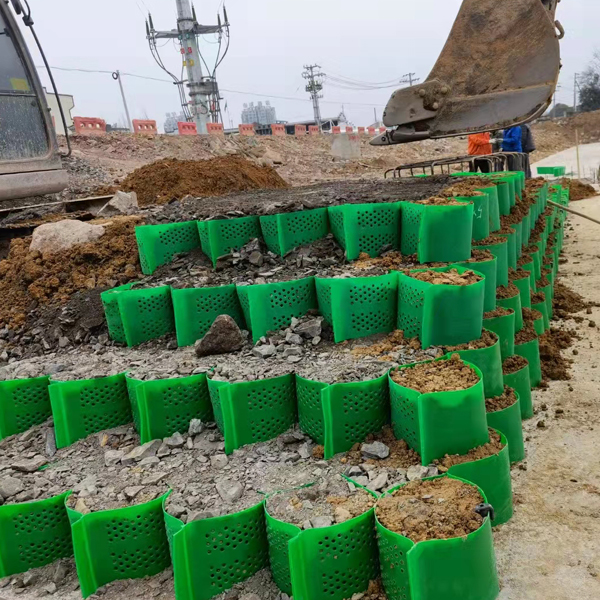
Geocell retaining walls typically employ a stepped layout. Each layer of cells contracts inward by a certain displacement, thus forming a specific slope.
Lateral Constraint Effect: The cell walls provide strong lateral pressure on the fill material, causing loose fill material (such as sand, gravel, and soil) to exhibit properties similar to a “rigid body.”
Integrity: The layers are connected by connectors, and combined with the friction between the cells, they form a composite structure with a very large self-weight, resisting the soil pressure behind.
2. Core Application Advantages
Compared to traditional concrete retaining walls, geocells offer significant advantages:
Flexible Structure: They can adapt to a certain degree of uneven foundation settlement. On soft soil foundations, concrete walls are prone to cracking, while geocells can release stress through slight deformation.
Excellent Drainage: The perforated design between geocell layers and within the geocells themselves provides excellent permeability. This eliminates the hydrostatic pressure behind the retaining wall, a major cause of collapse in many traditional retaining walls.
Landscape Design: The outermost geocells can be filled with vegetated soil and planted with flowers and grass, ultimately transforming the retaining wall into a “green wall” rather than a cold concrete wall.
3. Key Construction Steps
The construction process for geocell retaining walls is relatively simple and does not require large lifting equipment:
Foundation Excavation and Leveling: Prepare a compacted foundation.
Bottom Layer Laying: Open the cell blocks and secure them with U-shaped steel bars or nails.
Filling and Compaction: Fill with crushed stone or soil (it is generally recommended to fill the outer layer with soil for landscaping and the inner layer with crushed stone for drainage), and mechanically compact.
Layering Upwards: Repeat the above process, with each layer receding a certain distance according to design requirements (to create a slope ratio).
End Connection: Connect the cell blocks into a whole using high-strength connectors or nylon ropes.
4. Typical Application Scenarios
Steep Slope Protection: When slope space is limited and a conventional slope angle is not possible.
Riverbank Protection: Utilize its excellent drainage and erosion resistance to protect riverbanks from being eroded by water flow.
Highway/Railway Subgrade Widening: Used to reinforce newly added fill sections when widening existing railway lines.
5. Technology Comparison Table
| Characteristics | Geocell retaining wall |
| Foundation requirements | Low (minor settlement allowed) |
| Construction speed | Fast (modular installation, no maintenance required) |
| Ecological impact | Friendly (can achieve complete greening) |