


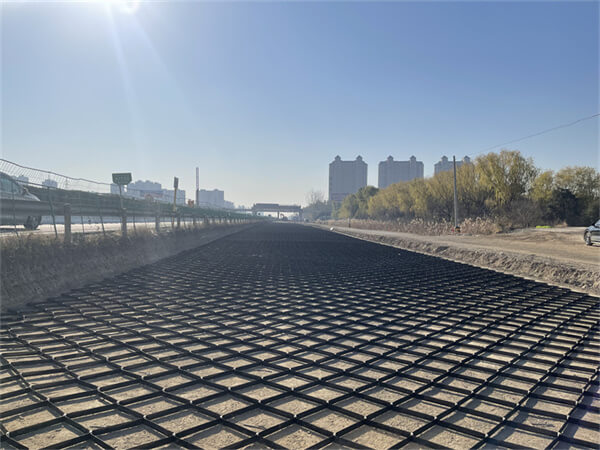
In soft soil foundation treatment, the core application of geocells lies in their combined effects of reinforcement, drainage, and settlement control. Due to the low strength and high compressibility of soft soils (such as silt, silty clay, and saturated clay), geocells, by constructing a high-stiffness composite cushion layer, dissolve pressures that could otherwise lead to roadbed collapse into stable stresses within the structure.
1. Core Reinforcement Mechanism: An “Artificial Raft” on Soft Soil
Before laying geocells, a layer of geotextile or sand cushion is usually laid to prevent poor drainage. After the geocells are laid, their working mechanism is as follows:
Stress Diffusion (Force Redistribution): Geocells can rapidly diffuse the concentrated load of the upper embankment onto a larger area of the foundation. In calculations, this is equivalent to increasing the bearing area of the foundation and reducing the contact stress on the soft soil surface.
Lateral Extrusion Constraint: Under load, soft foundation soil tends to be extruded laterally in all directions. The high circumferential stiffness of the geocell walls locks in the internal fill material, forming a “monolithic plate” with considerable shear strength, effectively curbing lateral displacement of the foundation soil (i.e., reducing so-called “lateral extrusion failure”).
2. Main Steps in Soft Soil Foundation Treatment
Foundation Cleaning and Leveling: Remove topsoil, level the site, and compact appropriately.
Laying a Drainage and Isolation Layer: Lay a layer of gravel or geotextile on the soft foundation to ensure effective drainage and prevent the geocells from being “squeezed in” by soft soil or “contaminated” by rare earth elements.
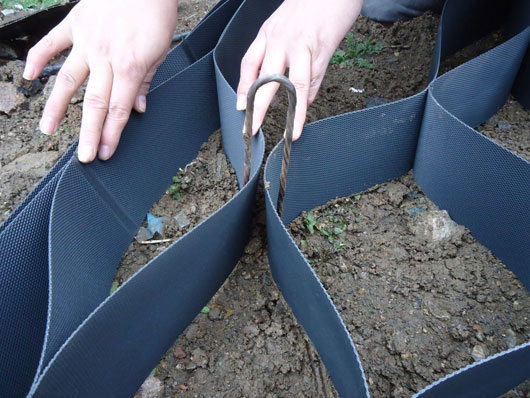
Unfolding the Geocells: Unfold the folded geocells along the design axis and secure them with anchor bolts or U-shaped steel nails to ensure full unfolding without wrinkles.
Filling: A critical step. Prioritize materials with good permeability such as crushed stone and sand. Adopt a filling sequence of “from the middle to the sides” or “from the sides to the middle” to prevent deformation of the geocells.
Layered Compaction: Small compaction machinery must be used for layered compaction to ensure the compaction degree of the fill material meets design requirements (usually above 90%-95%).
3. Key Advantages in Solving Soft Soil Problems
| Characteristics | Specific contributions to soft soil foundations |
| Increased overall stiffness | Improves foundation bearing capacity and prevents overall subgrade instability (slides). |
| Uniform settlement | Effectively suppresses initial subgrade settlement and reduces pavement cracking. |
| High construction efficiency | Compensates for uneven settlement caused by uneven soft soil layer thickness, preventing pavement fractures.Compared to traditional mixing piles or surcharge preloading, the construction period is significantly shortened. |
4. Common Design and Construction Considerations
Fill Material Selection: On soft soils, it is recommended to avoid using fine-grained silt or excessively cohesive soils (which easily generate pore water pressure). Crushed stone or gravel not only has high strength but also serves as a drainage channel for the foundation.
Combined Treatment: For extremely soft foundations, a single geocell is often insufficient; it is often used in combination with plastic drainage boards (PVD) or crushed stone piles. The geocell is responsible for stress diffusion, while the drainage board is responsible for accelerating foundation consolidation.
Geocell Height: For highly compressible silty soil foundations, it is recommended to use geocells with a height of 200mm or more to obtain a greater reinforcing moment.