


The Future of Soil Stabilization
About Geocells
GEOSYNTHETIC MATERIAL SERVICE PROVIDER
UNDERSTAND GEOCELLS
- 自 2004 年起,成为中国首家生产高密度聚乙烯土工格室的企业。.
- 质量管理体系通过 ISO9001:2015 标准认证。.
- 所有土工格室都通过了 SGS 和 BTTG 授权的 CE 认证。.
- 从原材料到每个生产流程都有严格的质量控制体系。.
- 可在 3 个工作日内提供免费的土工格室样品,以便进行质量评估。.
A key indicator that determines whether a project will collapse or subside in 20, 50 years or even longer.
ESCR ≧5000H is an abbreviation for Environmental Stress Cracking Resistance. It is one of the most important indicators for evaluating the long-term lifespan of polymer materials (such as HDPE).
Many substandard cell blocks have high strength when they are first laid, but because a large amount of recycled materials are used, their ESCR value is extremely low. After 3-5 years of operation, the cell blocks may break off like biscuits, causing the entire subgrade to fail.
Seven-day suspension test (weld joint creep test)
The welded joints of geocells are subjected to constant, long-term tensile force during engineering. While the instantaneous pull-out strength (from a sudden, forceful breakage by machine) is very high, this does not mean it won’t gradually detach under long-term stress. This phenomenon is called **creep**.
GEOCELL STANDARD
Geocell-Chinese-Standard
| Carbon Black Content | ASTM D 1603 | ≥1.5% |
| Density | ASTM D 1505 | ≥0.94g/cm³ |
| Sheet Thickness | ASTM D 5199 | 1.5mm |
| Seam Peel Strength | USACE GL-86-19 | ≥10KN/m |
| Tensile Strength | ASTM D 6693 | ≥18KN/m |
Geocell-ASTM-Standard
| Carbon Black Content | ASTM D 1603 | ≥1.5% |
| Density | ASTM D 1505 | 0.935-0.965g/cm³ |
| Sheet Thickness | ASTM D 5199 | 1.5mm |
| Seam Peel Strength | USACE GL-86-19 | ≥14.2KN/m |
| Tensile Strength | ASTM D 6693 | ≥25KN/m |
| Environmental Stress Crack Resistance(ESCR) | ASTM D 1693 | ≥5000hrs |
| Oxidation Induction Time(OIT) | ASTM D 3895 | ≥150min |
Geocell-NPA-Standard
| Index Properties | Test Method | Value |
| Polymer | - | NPA |
| Thickness | - | 1.5 mm |
| Density | ASTM D 1505 | ≥0.94 g/cm³ |
| Seam Peel Strength | ISO-13426-1 Part 1 Method C (1) | ≥19 kN/m |
| Tensile Strength | ISO 10319 (2) | ≥23 kN/m |
| Dynamic Mechanical Analysis (DMA) at sample elevated temperature: +30°C +45°C +60°C |
ISO 6721-1 ASTM E2254 (DMA) |
>775 >675 >525 |
| Cumulative Permanent Deformation (Creep Resistance) Stepped Isothermal Method (SIM): Step 1 at 44°C Step 2 at 51°C Step 3 at 58°C Step 4 at 65°C |
ASTM D-6992 (SIM) | ≤3.0 % Cumulative Deformation |
WHAT TYPE OF GEOCELL SHOULD BE CHOSEN?
| Geoleed - Retaining Walls | |||
| GD 445 - 150mm/200mm | GD 660 - 150mm/200mm | ||
| Cell Embedment | Panel Expansion | Cell Embedment | Panel Expansion |
| 3 cells | 4.48 m × 0.87 m | 3 cells | 4.70 m × 1.35 m |
| 4 cells | 4.48 m × 1.16 m | 4 cells | 4.70 m × 1.80 m |
| 5 cells | 4.48 m × 1.44 m | 5 cells | 4.70 m × 2.25 m |
| 6 cells | 4.48 m × 1.73 m | 6 cells | 4.70 m × 2.70 m |
| Geoleed - Base Stabilization | ||
| 应用 | Type | Cell Depth |
| Horse Paths, Yards, ATV Trails | GD254/GD330 | 50mm/100mm |
| Pavement, Bike Lanes | GD356/GD445 | 75mm/75mm/100mm |
| Parking lots, Light Vehicles, Light Industrial | GD330/GD356/GD445 | 75mm/100mm/120mm |
| Large Vehicles, Heavy Industrial | GD356/GD445 | 100mm/120mm/150mm/200mm |
| Airport Runways, Railways Support, Pier | GD356/GD445 | 150mm/200mm/250mm |
| Tree Root protection, Subbase Stabilization | GD660/GD712 | 200mm/250mm/300mm |
| Geoleed - Channels | |||
| Flow Velocity | Type | Cell Depth | Infill Material |
| Up to 3 m/s | GD330/GD356 | 100mm/150mm/200 | Angular Rock |
| Up to 6 m/s | GD356/GD445 | 100mm/150mm/200 | Vegetated Soil |
| Over 6 m/s | GD445/GD660/GD712 | 100mm/150mm/200 | Concrete |
| Geoleed - Slope | ||
| Slope Steepness | Type | Cell Depth |
| 6:1, 5:1 or less | GD660/GD712 | 100mm/150mm |
| 4:1 | GD356/GD445/660 | 100mm/150mm |
| 3:1 | GD445/GD660 | 150mm/200mm |
| 2:1 | GD356/GD445 | 150mm/200mm/250mm |
| 1:1 or steeper | GD356/GD445 | 200mm/250mm/300mm |
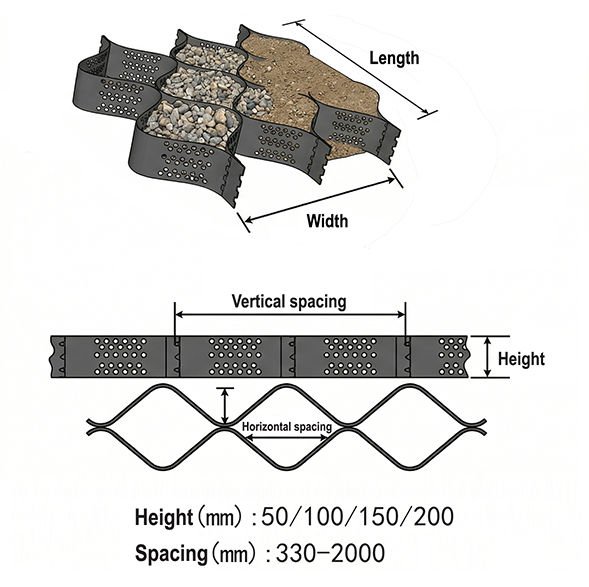
Geocell Models
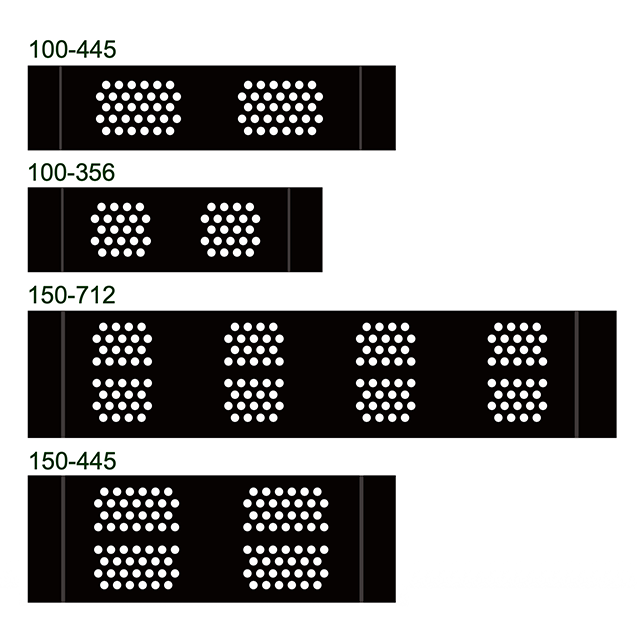
Geocell Holes
INSTALLATION GUIDE
总部
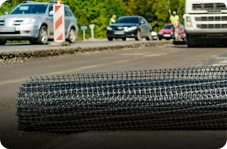
土工格栅
土工织物
土工膜
复合材料
建筑材料