


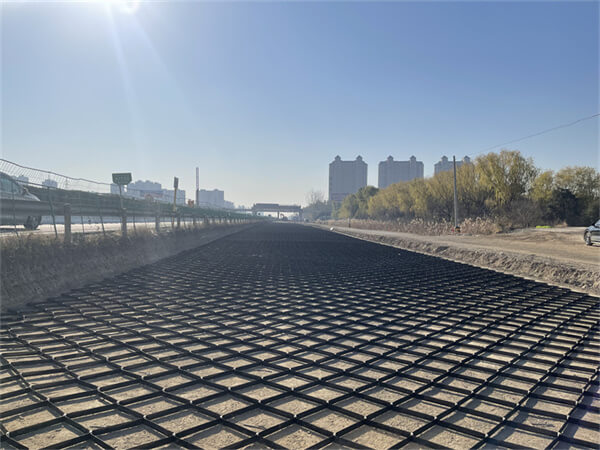
In road engineering, the application of geocells to the pavement base course aims to transform traditional crushed stone base courses into high-performance, flexible, reinforced composite base courses. This design is particularly suitable for heavy-duty traffic roads, freight corridors, or sections with weak foundations, designed to address early pavement damage such as rutting, subsidence, and cracking.
1. Core Function: Constructing a “High-Stiffness, Fatigue-Resistant” Base Course
As a reinforcing material for flexible base courses, geocells exert a mechanism far exceeding that of ordinary crushed stone layers:
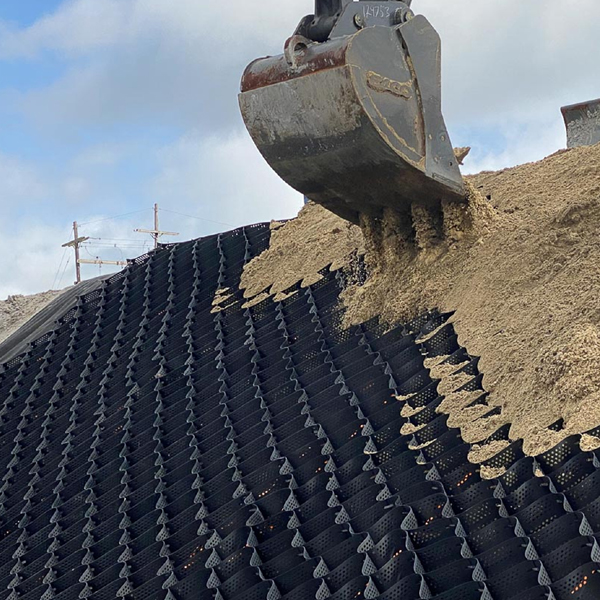
Lock-in Effect under Dynamic Loads: When vehicles travel, the load is transferred to the pavement base course. Ordinary crushed stone layers experience lateral displacement under repeated pressure, leading to base course loosening. Geocells, with their high-strength walls, lock the filler material in place, restricting the lateral movement of the crushed stone, allowing the load to diffuse deeper at an angle of approximately 45°, significantly reducing stress in the subbase.
Rutting Resistance: Rutting typically originates from the lateral flow of base course materials. The lateral restraint provided by geocells acts like countless tiny retaining walls, significantly increasing the shear modulus of the base course and effectively preventing pavement subsidence caused by heavy vehicles.
Anti-reflective cracking: When minor differential settlement occurs in the underlying subgrade, the flexibility of geocells allows them to act as a “bridge,” preventing deformation of the underlying layer from being directly transmitted to the upper asphalt pavement, thus reducing the occurrence of reflective cracks.
2. Design Considerations and Technical Parameters
In base course applications, selection typically follows this logic:
Cell height (H): Generally 100mm to 150mm. Higher height means more restrained fill material and a higher overall modulus.
Fill material selection: Strict requirements. Graded crushed stone or gravel is typically used.
Critical: The maximum particle size of the fill material should not exceed 1/2 or 1/3 of the cell height.
Grading requirements: Continuously graded crushed stone must be used to ensure compaction density and interlocking force after compaction.
Compaction Degree: This is the lifeline of base course reinforcement. Vibratory rollers must be used for layered compaction to ensure the compaction degree meets design specifications (typically, the base course requires a compaction degree greater than 96% or higher).
3. Application Comparison: Ordinary Base Course vs. Geocell Reinforced Base Course
| Performance Indicators | Ordinary Crushed Stone Base Course vs | Geocell Reinforced Base Course |
| Load Diffusion Angle | Smaller (Stress Concentration) vs | Larger (Uniform Stress Distribution) |
| Shear Strength | Depends on Crushed Stone Internal Friction Angle vs | Crushed Stone Interlocking + Geocell Constraint (Significant Improvement) |
| Pavement Life | Normal vs | Expected Extension: 20%-50% |
| Construction Difficulty | Moderate | Requires Geocell Deployment and Fine Compaction |
4. Pitfalls to Note During Construction
Insufficient Cell Deployment: If the cells are not fully deployed, gaps will appear in some cells, preventing the formation of an effective constraint loop.
Weld Joint Delamination: Under heavy crushed stone, if the cell material is brittle or the weld quality is substandard, the cells may crack. Therefore, the toughness of HDPE and the weld strength must be considered when selecting materials.
Impurities in the Filler: If the filler contains too much soil, it will significantly reduce the frictional resistance between the crushed stone, causing the cells to lose their constraint effectiveness.